
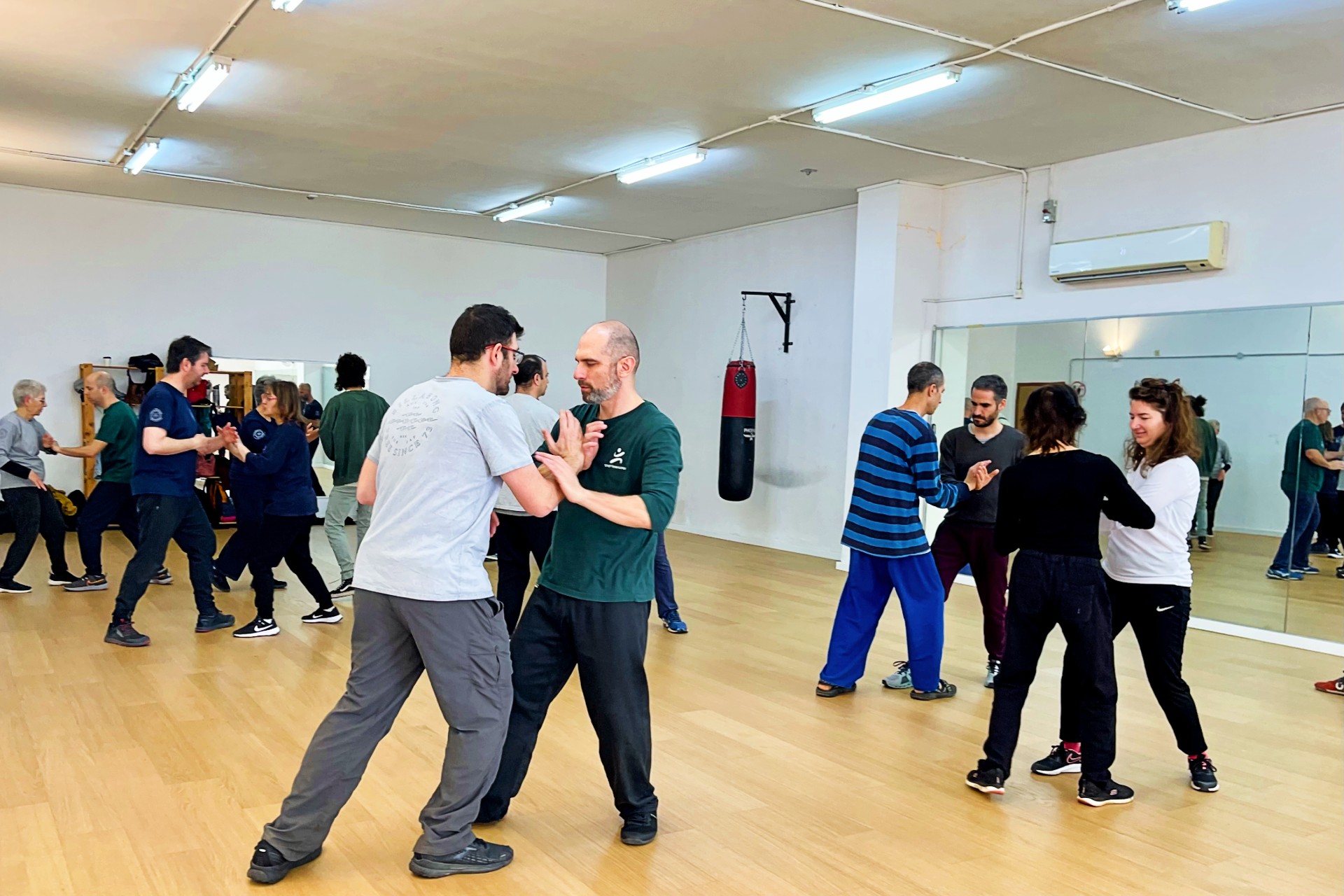
Pushing Hands
One of the most intriguing aspects of tai chi is the "pushing hands", "Tui Shou" in Mandarin. A traditional form of practice with diverse forms, and is the basis for the martial applications of tai chi.
Pushing hands exists in different and varied forms in all tai chi styles. It sharpens the practitioner's fighting skills by improving posture, balance, softness, coordination, and of course strengthening the inner strength.
Pushing hands variations include simple patterns practiced with only one hand, more complex patterns that are practiced with both hands and with leg movement, and also free practice which is a type of sparring that allows simulating real combat situations in a controlled and safe environment.
Pushing Hands – Principles
Pushing Hands is a core practice in tai chi that demonstrates the essence of the art – the harmonious integration of body, mind, and energy. At its core, pushing hands is an exercise in which two practitioners engage in a series of controlled movements that involve pushing, pulling, and redirecting each other's power.
The most basic and important principle of tai chi is "softness overcomes hardness", and therefore pushing hands practitioner is required to learn to release, focus, listen, guide, and maintain balance. The holistic sensitivity that is learned and built from practice, allows the practitioner to interpret and redirect, without the use of force, the opponent's energy, and neutralize the attacking force.
This ability is the result of understanding and applying the main principles of pushing hands that emphasize the cultivation of sensitivity, balance, and adaptability. Using these principles, and acquired skills, the practitioner learns to listen to the movements and intentions of the opponent through contact, to locate the weak points in his structure, to destabilize his center, and thereby disrupt his external and internal balance. Then, by adding energy with a slight effort, the counterattack can be completed in the desired manner and direction.
Pushing hands techniques may appear, at least at first, to be counterintuitive, but this is perhaps the main reason why they work. When force is exerted on us, the natural tendency is to react with tension and resistance. Pushing hands actually teaches us to relax while taking action. This state of release makes it possible to integrate with the opponent's movement and neutralize it. When the opponent notices that something has changed, it is already too late and the control is already in our hands.
Pushing hands training is an excellent basis for developing a medium-short range defense and attack techniques, and can be used to improve fighting skills. It fosters a deeper connection to the body and the environment and improves the practitioner's ability to respond effectively to dynamic situations. It is also an excellent tool for newer students to develop fighting skills in a less aggressive, more sophisticated, and more intuitive way.
Important Skills
To excel in pushing Hands, one must learn and refine a number of skills:
Rooting: the ability to maintain a stable and strong base, called rooting, is the most important skill in pushing hands. Good rooting is the basis that allows the absorption of external power and redirects it.
Sensitivity: Developing sensitivity is essential. The practitioners learn to "listen" and follow the movement, intention, direction of the force, and the strength of the partner through touch while anticipating and being able to adapt to changes.
Timing and coordination: precise timing and coordinated movement, each separately and both together, are key to success in practice. Precise timing makes it possible to prevent and disrupt the opponent's moves, while coordinated movement allows for an immediate, fluid, and smooth reaction.
Neutralization: Instead of meeting force with force, tai chi emphasizes the containment and neutralization of incoming energy. This principle allows the practitioner to redirect the opponent's energy, and if necessary, even use it against him.
Pushing Hands – The Learning Stages
Pushing hands is a fascinating and enlightening journey of developing abilities as well as research and self-discovery. In the various stages of the journey described here, the practitioner gradually perfects his skills and learns about himself and how to express his character and personality within the framework of the practice with different partners.
The foundation stage: In this initial stage, the focus is mainly on the development of the basic principles and skills. Students learn to maintain correct posture and balance, achieve release and calmness, understand basic body mechanics, recognize intention and directions of force, and cultivate sensitivity to the partner's movements.
Cyclic exercises: Cyclic exercises are predetermined movement sequences performed with a partner. These exercises allow the practice of techniques and principles in a controlled environment while improving basic skills and muscle memory.
Free practice: Free practice is live training performed spontaneously, without a predetermined pattern, and is the heart of training. During live practice, the practitioner responds to the partner's movements, changing in pace and direction in real time, using the basic skills and principles learned in the cyclic exercises. This stage further sharpens the abilities of sensitivity, adaptation, and response.
Advanced techniques: In this advanced stage, which requires self-control and self-discipline, the practitioner integrates fighting techniques into the practice of pushing hands. By practicing advanced techniques, you can practice self-defense scenarios, and the ways to effectively control and neutralize your opponent.
From Pushing Hands To Fighting
The applications of pushing hands go far beyond the practice itself. The skills acquired through training translate directly into improved fighting abilities and can therefore also benefit practitioners of other martial arts. The emphasis on sensitivity, timing, and neutralization in pushing hands aligns with the core principles of effective combat techniques across different and diverse disciplines.
The sensitivity that develops during the practice allows practitioners to develop a more accurate timing, which gives a split-second advantage in combat scenarios. Moreover, the ability to sense and direct power is invaluable for effective attack prevention and energy conservation. This synergy between pushing hands and martial ability has led many martial artists, regardless of their primary discipline, to incorporate elements of pushing hands into their training program.
Diverse Approaches: Soft And Powerful
Pushing hands practice encompasses a spectrum of characteristics, from soft and flowing movements to more intense and free practice. The soft practice emphasizes release, sensitivity, and inclusion, and allows the student to focus on internal aspects, refining the flow of energy and neutralizing tensions. The more intense practice helps to develop physical strength, endurance, explosive power, and martial applications.
Regardless of age, fitness level, or previous experience, pushing hands offers something for everyone. For beginners, it provides a gentle introduction to the principles of tai chi and body awareness. Intermediate students enjoy learning new techniques and improving existing skills. Advanced practitioners discover new layers of understanding as they deepen their connection to training and refine their fighting abilities.
In conclusion, pushing hands is not only a cornerstone in tai chi but a gateway to physical and mental excellence. Its principles of sensitivity, balance, and adaptation sharpen the various aspects of tai chi and make it possible to improve movement skills and fighting abilities. At our school, pushing hands is an inseparable component of the curriculum, as part of the empowerment journey that the students go through to find their inner strength, connection to others, and constant improvement.
